CLOUD VALLEY MUSIC
· Home · Cloud
Valley Home · News & Live · Reviews · Andrew
Cronshaw · SANS · Contact ·
SANS: SANS Live
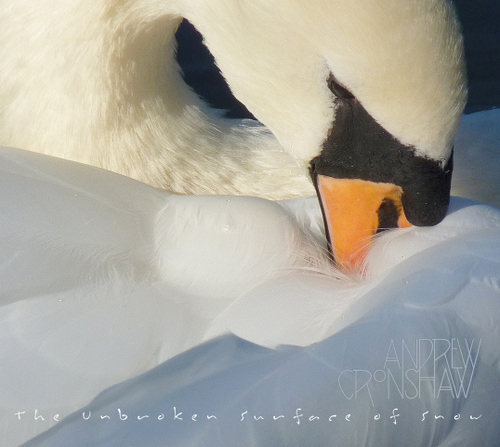
Andrew Cronshaw: The Unbroken Surface of Snow
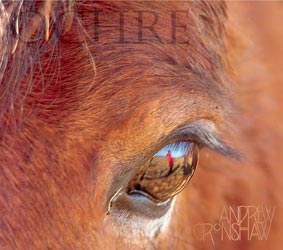
Andrew Cronshaw: Ochre
Andrew Cronshaw: On the Shoulders of the Great Bear
Žegar Živi: Žegar Živi
Reviews of Cloud Valley CDs
Click an album title below to jump
to extracts from its reviews
The Unbroken Surface of Snow
Žegar Živi
Ochre
On The Shoulders Of the Great Bear
Andrew Cronshaw is a bravely experimental British composer and
multi-instrumentalist who is also a journalist. His last album, the much-praised
Ochre, released seven years ago, matched English folk melodies against Middle
Eastern instrumentation.
Here he is joined by three other musicians, including
Tigran Aleksanyan, a master of the Armenian duduk, for drifting and mostly
instrumental compositions that include echoes of British or Armenian traditional
melodies. Three tracks are duets with Aleksanyan, with Cronshaw playing the
gently chiming zither, whistles, pipes or the enormous Slovak fujara flute.
There's a solo zither treatment of a stirring Scottish traditional melody, and
the remarkable 34-minute title track, based on a Finnish creation myth, on which
zither and duduk are joined by clarinet, saxophone and singer Sanna
Kurki-Suonio, apparently improvising the melody that suddenly enlivens this
delicate, haunting exercise in glacial mood music.
- Robin Denselow, The Guardian
The 34-minute title track is a Finnish creation myth set to a musical landscape that is as close to silence as heavy snowfall, and more beautiful" - Tim Cumming, The Independent
Stunningly beautiful - Fiona Talkington, BBC Radio 3
A consummate piece of instrumental story-telling in steady
growth. Music of snowflake-like singularity
- Ken Hunt, fRoots
The music is sparse, glacial and utterly beautiful, with a
wide, panoramic sense of infinite space: you will happily lose yourself again
and again in the title-track, a far northern wilderness transformed into sound.
- Tim Cumming, Songlines
Absolutely exquisite - Mary Ann Kennedy, BBC Radio Scotland / BBC Radio 3
Andrew's music always sounds so naturally integrated, so right; in spite of its diverse sources, the movement from genesis of ideas to recording is a truly organic process. The wide-open sound vistas evoke winter journeys across a bleak, snowy Scandinavia (trips that Cronshaw has himself made). There is a deep introspection to most of the five pieces and an unhurried pace to their conception but this is never less than entrancing and an immersive experience. - John Crosby, R2
Sublime - Max Reinhardt, BBC Radio 3
Andrew Cronshaw's music is a lovely marriage of various venerable traditions, meticulous construction and spontaneous invention. Spacious, gracious, subtle, quietly surprising - Doug Spencer, ABC Australian national radio
Unfolds, seduces and ultimately mesmerises - Tony Hillier, The Australian
Sometimes while listening you discover a snatch of a melody that evokes a memory of familiar music. But what Cronshaw et al do with these traditional sources borders on magic. The Unbroken Surface of Snow is an orgy of relaxation, meditation, mood, reflection - Marius Roeting, New Folk Sounds (Netherlands)
A palpable sense of space and peace - Norman Chalmers, Scotland on Sunday
Here is a great beauty that you might not notice
immediately; it took me several months.
The music just came flowing towards me, as if I was on a summer meadow, looked
up at the sky and saw white clouds drift past. Or a winter night out in the
country with the Milky Way's glittering ribbon of stars.
Such occasions when there is all the time in the world and no boundaries
- Lennart Wretlind, Swedish national radio P2
If the BBC ever make a sequel to Frozen Planet, here surely is its emotive soundtrack - David Quantick, Uncut
A stunning but subtle new recording. These musicians bring
to life a quiet, sometimes almost silent musical landscape that defies any genre
or category you might try to put it in -
CDRoots (USA)
Music with an almost tangible sense of space
and history, yet with none of the constraints that come with genre
-
Richard Thornley, Penguin Eggs
(Canada)
Andrew Cronshaw is a true pioneer of the world music/roots
scene. Years ago, Cronshaw captivated listeners with his glistening zither
playing on traditional English, Irish, and Scottish tunes (it's worth revisiting
Till The Beasts' Returning, or the recently
reissued The Great Dark Water). There would
be hints of Cronshaw's wide-open ears, and an affinity for Finnish (especially
On the Shoulders of the Great Bear from
2000) and other music of far northern climes. 2004's
Ochre brought Cronshaw back to the music of the British Isles, but
infusing the tradition with guests from other musical traditions. And now, seven
years later, comes the equally unhurried The Unbroken Surface of Snow.
Like the title of the album itself, the
compositions hint at broad expanses of space, and in fact the music develops as
if hanging over a frozen desert. On three tracks ("Käärme", "Fujaruk",
and the live "Im Hogutz"), Cronshaw is accompanied by Tigran Aleksanyan
on the duduk. The duduk's low tones sweep and call over the empty space here,
while Cronshaw adds zither, reed pipes, fujara (a Slovakian shepherd flute),
kantele, and the Chinese ba-wu flute to the mix. Each track is an exercise in
minimalism, and while composed (Cronshaw mentions in the liner notes that
"scattered throughout are traditional melodies, mostly English or Armenian, or
fragments of them") there is empathic improvisation between the musicians as
well. The tracks between Cronshaw and Aleksanyan are instructive for not only
what is said by each, but also by what is not said in this deep, unfolding
music.
"The Unbroken Surface of Snow"
is a journey in itself, derived from the Finnish national epic The Kalevala.
Cronshaw and Aleksanyan are joined by Ian Blake (soprano sax) and Sanna
Kurki-Suonio (vocals; Kurki-Suonio sang in the group
Hedningarna).
Kurki-Suonio brings us the runo-song of how Väinämöinen created the world;
following tradition, she also fashions her own tune in the process. At nearly
thirty-five minutes, the result is an ever-shifting piece of enacted, beautiful
magic.
Whenever Cronshaw's zither ("Mhàiri
Mhin Mheall-Shùileach" is a solo piece) or kantele playing emerges, I'm
overcome with feeling as if some long-lost memory of mine is shifting under a
frozen crust of snow. Ultimately, The Unbroken Surface of Snow is a bold
exercise in contemplation; and like snow itself, it falls silently and
accumulates additional weight and resonance with repeated listening.
- Lee Blackstone, Rootsworld (USA)
Žegar Živi
"A very special album of a unique song tradition that’s beautifully recorded... it's music that you listen to and you marvel at" - Lucy Duran, BBC Radio 3 "World Routes"
"It can seem other-worldly, but it's
also earthy and uncompromising"
- John L. Walters, The Guardian
"Beautiful singing" - Mary Ann
Kennedy, BBC Radio 3 "World on 3"
"This bewitching record... These recordings have a wonderful immediacy"
- Michael Church, The Scotsman, 29.2.08
"Žegar Živi is the real thing" - Michael Church, The Scotsman, 7.3.08
"One suspects it could turn out to be a ground-breaking venture" - Phil Wilson, fRoots
"As a hardened philistine when it comes to English folk music, I was taken aback to find myself enjoying an album whose sleeve note documents the exact provenance of each track, establishing that they are all indeed English folk tunes.
…the musicians approached the melodies with fresh ears, and the result is an album that will be surely welcomed with open arms throughout the world."
- Charlie Gillett, BBC Radio London & BBC World Service
"One of the finest albums of the year" - Fiona Talkington, BBC Radio 3 Late Junction
"It’s the sense of rootedness in a gritty, marginal England that allows this music its brush with profundity. And the fact that this landscape exists principally in Cronshaw’s head makes the achievement
all the more impressive."
- Mark Hudson, Daily Telegraph
"This fabulously restrained and crystalline-cool album
consists of, strange to relate, versions of English folk tunes. Dominant
cultures generally don’t do folk very well (in these islands, Irish or Scottish
folk has a lot more spirit) because folk music has always been a way for
cultures under threat to rebel and forge a sense of identity.
Cronshaw’s take on English folk has a twist - it’s recorded with a panglobal ensemble...
The result is splendidly unclassifiable. Cronshaw is a musical adventurer.
My first impression of
Ochre was
that it could if anything be too tasteful - the kind of thing you might hear in
an upmarket spa. But further hearing reveals something deeper, woven with a
filigree of sounds - a meditative sense of landscape and place, with occasional
shafts of illuminated light."
- Peter Culshaw, The Observer
"It's exotic and
mysterious, and it comes as a shock to realise that the music being played is
actually English" - Colin Irwin, fRoots
"Consummate musicianship it may have, but it is
the ideas that seethe and shoal in this music that really excite."
- Ken Hunt, Record Collector
"For a man with such a substantial discography and back catalog of collaborative enterprises to his credit, Andrew Cronshaw has somehow
managed to maintain a relatively quiet profile. Working with diverse artists,
master of eclectic instruments, and journalist on a wide range of traditional
music, it is not surprising that Cronshaw’s musical horizons have taken him a
long way from his British musical origins.
Ochre seems,
on paper at least, to be the mark of the full circle. It is an album based on
seven traditional English songs, and would appear to be something of a
home-coming project, a chance for Cronshaw to zoom in on his own cultural
soundings. But then one turns on the CD player, and the reality is very
different. The ‘Englishness’ of the project is not much in evidence at all.
Instead, we are compelled to explore the universality, the wider outlook and
potential of a tradition. Through the employment of an array of instruments -
harp, whistles, voice, piano, double bass, oud and more - the essence of each
song is taken on a journey like never before. Over freezing seas and desolate
mountains, through ghostly castles and smoky jazz clubs, the core of each song
is teased out, given the space and time to breathe." - Jennifer Byrne, Sing Out! (USA)
"Stripped of their English lyrics, the songs grow
contemplative rather than narrative, but the old strangeness of the tunes is
only enhanced by colorful instrumentation and understated performances:
Cronshaw’s zither has a crystalline, starry presence, given roundness by
Chhadeh’s qanun; the grim murder tale Lucy Wan is rendered airily unearthly
with just a ghostly harmonic whistle against Bernard O’Neill’s droning bass
while Sofía, The Saracen’s Daughter is sung in Arabic by Natacha Atlas. This
tale of a landowner kidnapped in Turkey, who befriends the jailer’s daughter,
who sets him free and years later follows him to England, holds the key to this
disc: the heart and soul know no boundaries."
- Tom Jackson, Global Rhythm (USA)
"Treating a variety of British folk-songs by performing
them with unlikely varieties of instrumentation - Greek lyra, Syrian kanoun,
prepared piano and the vocals of Egyptian/British singer Natacha Atlas -
Cronshaw creates elegiac, dreamlike textures that override the tunes’ origins
and which place them in a global context. Slow-moving and reflective, the album
sets its own languid pace. - World Music Charts Europe
If anyone is guaranteed to create an exciting, stimulating and totally different album - even when the music’s origins are
very familiar – it’s Andrew Cronshaw. With his mastery of various exotic
instruments and his extraordinary musical vision, he never fails. Like previous
albums, it’s brilliantly adventurous, though it’s an adventurousness
characterised by remarkable restraint." - Keith Hudson, Taplas (Wales)
"As a passionate explorer of the world’s musical
undercurrents, there’s not a lot that surprises me any more. Yet once in a
while I come across a completely unexpected type of music that is so incredibly
beautiful that I stop all I’m doing and at the end of the record can only do
one thing: hit the repeat button."
- Ton Maas, Ode (USA & Netherlands)
"This man is an English original. He paints
unusual sound pictures with the melodies we love and brings out totally
unexpected aspects of them." - Vic Smith, The Folk Diary
"In a just world, a man with the talents of
Andrew Cronshaw would be a household name.
Cronshaw is a musician/producer of
rare quality. Don’t worry about categorising this album as folk, classical,
world or any other kind of music - just file under 'Essential'." - Mel McClellan, BBCi
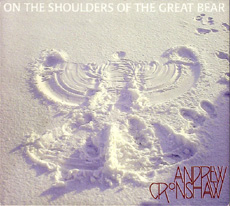
ON THE SHOULDERS OF THE GREAT BEAR
"Perhaps as a result of our being such a mix'n'match culture to
begin with, British musicians excel in the subtle art of hybridisation. The
average American muso, faced with the task of reconciling apparently disparate
cultural modes, is more likely to use them as separate, ethnically 'correct'
sections in some grandiose multipartite composition that has as little to do
with the notion of combination as American society has with the notion of a
'melting pot' culture. We Brits, on the other hand, are fortunate enough to live
in a culture that, rather than viewing other cultures with suspicion, exults in
their very difference and seeks to introduce their music into our native
strains.
There are few more specific indicators of a country's
culture than its folk music, yet as far back as the mid-Sixties, the likes of
the Incredible String Band were introducing such exotic elements as sitar and
gimbri into their Celtic-mystic whimsy, with unparalleled commercial success.
The zither virtuoso Andrew Cronshaw is, in some ways, the ISB's direct
descendant. He has sought in his records to find some rapprochement between folk
and New Age music, while his performances have struck out from folk's
traditional bar-room home - in the early Nineties, for instance, he did a tour
of English village churches.
Cronshaw's musical wanderlust drew him to Finland for
1993's The Language of Snakes, a connection that this long-awaited
follow-up develops further. The most obvious link is between his zither and the
Finnish kantele, but Cronshaw takes the connection further by introducing the
marovantele, a hybrid of kantele and marovany, the Malagasy instrument familiar
to him from his work with Madagascar's excellent Tarika. When that instrument is
used to suspend twinkling trails of notes behind Ian Blake's meditative soprano
sax figures, as on
Ema Haual/Hällilaul, the effect is utterly enchanting. The tunes are
mostly taken from traditional Finnish and Ural airs, along with a few others of
Celtic derivation, but in each case Cronshaw blurs the borders to produce
something unique, whether it is the layers of shawm, sax and concertina adding
warm, Celtic textures to
Halullinen Sielu/Käin Minä Kaunista, or the Finnish singer Jenny Wilhelms
offering a vocal interpretation of a Gaelic lament. Most striking of all is the
title track, a reference to Finland's place in relation to Russia, in which
jew's-harp sets up a hypnotic resonance behind the bizarre growled rap that
Heikki Laitinen constructs from mythological runic imagery. Even at this early
stage, it's safe to say you'll hear nothing else like it all year."
- Andy Gill, THE INDEPENDENT
"Andrew Cronshaw's astonishing record is the album Oregon never
made. Where they were sober and punctiliously eclectic, he is joyous and
playful, and still utterly loyal to the traditions he explores. The cover
photograph of his outline squirmed into fresh snow tells you most of what you
need to know, for this is music that rightly relegates 'personal' expression to
the ghostly fringes. It is utterly un-self-indulgent."
- Brian Morton, SONGLINES
"a serene sense of purity beyond the
realms of anything else most people have in their collections, yet paradoxically
sounding familiar enough to be welcoming too."
- Colin Irwin, fROOTS
"...opens with the distant tolling of
Finnish church bells. Under that Cronshaw slides the recorded debut of the
'marovantele' - a zither cross between Finland's kantele and the Malagasy
marovany - playing two Estonian airs. Soprano saxophone, string bass and effects
add to the atmosphere. Therein lies Cronshaw's gift. To list the sources of his
material as Finnish, Ingrian, Estonian, Siberian and Scottish Gaelic may make
this music sound fearsomely recondite but he is a master of atmosphere." *****- Ken Hunt, CLASSIC CD
"One of my top CDs of 2000, from
anywhere in the world. Inspired composition, inspired music..."
- Fiona Talkington, BBC Radio 3 LATE JUNCTION
"An enthralling album that proves that Northern Europe can be as much a source of 'world music' as Africa or Latin America." - Dave Laing, MUSICIAN
"...the energetic, gritty title piece
that features the unique sub-verbal growlings of one of Finland's national
treasures, vocalist Heikki Laitinen, colliding and swirling with the instruments
like a Bosch landscape. Andrew Cronshaw may not be prolific, but each of these
fourteen songs is worthy of the waiting."
- Cliff Furnald, ROOTSWORLD
"Cronshaw has taken sixteen traditional
tunes, some are Finno-Ugrian (from Finland, Ingria and Estonia), one is
Ob-Ugrian from Siberia and three are from the Scottish Gaelic-speaking
tradition, and created a masterpiece with them. All are quite exquisite. ....a
remarkably wonderful album, it washes over you taking you to new landscapes and
new places within your psyche. For me it was a very melancholic place, a soulful
place. It's great when an album hits you just right. If you like northern
European music, its delicate nature, the hypnotic charm, then you'll be bowled
over by this wonderful collection of tunes."
- Tim Arthur, ENGLISH DANCE & SONG
"Here he plunges deeper and with even greater authority into ancient Finno-Ugric traditions, creating the sort of masterpiece that only he could. This is an album of starkly haunting beauty, full of unexpected twists and turns and it demonstrates once again Cronshaw's unique creative genius." - Keith Hudson, TAPLAS
For reviews of earlier
Andrew Cronshaw albums click
here; it takes you to the Press page at
www.andrewcronshaw.com